Sunday, September 16, 2007

The Future of Food

After reading both Ruth Ozeki’s All Over Creation and Michael Pollan’s The Omnivore’s Dilemma, we watched a film on food called, The Future of Food. As mentioned before in Ozeki’s book, the terminator gene was introduced into the foods we grow for the simple purpose of forcing farmers to buy more seeds more frequently. These genetically altered seeds grow a crop of food like normal, but then ‘terminate’ themselves by killing itself. Seeds that used to be found in various foods now are gone, thus reusing and continuing the cycle is not an option anymore. Personally, I thought foods no longer contained seeds because of the inconvenience of having to remove them, rather then just eating the food whole. An example, watermelon. A favorite summertime snack that was always refreshing and sweet. Well, used to be. I used to think that seedless watermelons were so hassle free, and they were, I was just forgetting the fact that it also had no taste. The red, juicy sweet watermelon I long for is just no competition to its replacement.

The movie mentioned seed banks, also covered in All Over Creation. Except, the large company of Monsanto decides to take every seed that has not been claimed and place it under their name. Is it possible to place a patent on nature? Not only that, they went as far as to suing small farm farmers for ‘stealing’ what was rightfully theirs. Seed banks are here for the sole reason of providing a sustainable backup incase anything goes wrong. Why are companies fighting over something that belongs to everyone?

In Pollan’s book, his first section is dedicated to corn. But because there is a surplus amount of corn in this world, farmers end up losing money due to the abundance in crops. As mentioned in both the book and the film, farmers pay around $3.20 to grow a bushel of corn, but only $2.20 is returned back to the farmer’s hands. So what happens to that one-dollar difference? The government helps make ends meet by providing the difference that’s missing for every farmer. But then what’s the point of coming out even and having to throw away large amounts of perfectly good corn?

The other thing I noticed was the irony of shipment and imports. The film stated that apples were being imported across sea from China. We live in Washington, also known to outsiders as the apple state. We are famous for our apples, why do we need to have apples sent all the way from Asia? Are they better tasting? Still, it’s ridiculous to waste so much gas to transport it from its original place to our local grocery stores.

Pizza Day

Awhile back, my class had the opportunity to make our own pizzas, which were to be baked in an oven created over the summer located at the UW farm. The dough and cheese were the only ingredients that were bought, and some ingredients that went into the pesto, but they were all from Trader Joe’s. A week earlier my group worked on making the pesto in the HUB’s kitchen. The basil we used was actually grown at the UW farm and given to our class when we went to go visit a few days earlier. Pesto is one of those foods that are easy to make, yet tastes delicious. I couldn’t get enough of it, even if I did have garlic breath afterwards.

The veggies we used as toppings were picked that morning at the UW farm and placed on a cutting board for us to decide how much and which types we wanted to go on our pizzas. I ended up putting tomatoes, bell peppers and zucchini on top, with a sprinkle of cheese over everything.

Unfortunately, the dough we had rolled out earlier stuck to our paper plates, but with some tugging and patience, we all got ours off and into the oven. Flour was a lifesaver that day. Several minutes in the new oven and with Keith’s help, we all got to taste our own pizzas. Crafted by hand and made locally. I got my serving of vegetables that day.

It was quite simple and tasty, but more importantly, we knew where our food came from, the majority of it. Organic and fresh so we didn’t have to wonder how many days it had spent in the back of a truck, traveling from who knows where. I’ll have to try to make my own pizza once I get home.

Beyond Boundaries

Industrial productions seem to be working out fairly well, allowing machines to do all the hard labor and feeding millions efficiently. But this was before I read an article called, Beyond Boundaries by Barbara Noske. Not only do the animals suffer, the workers are affected as well. Just like the one type of cauliflower engineered to withstand long distances and periods of traveling from factories to stores, animals nowadays are going through the same thing. They are being engineered for one specific task, whether it is for the chickens to lay eggs, the cows to produce milk, or various others to grow fur. Is this really natural? To force animals away from the way they originally were, to becoming in a way, a device to hand out eggs like a vending machine. I never gave my omelet much thought, thinking chickens really do produce eggs in such large quantities and in that short of a time.

Aside from generic alterations, their new habitats are not any better. Animals are confined in such small places that they easily become bored. Due to boredom, they find ways to entertain themselves. As with pigs, they end up biting each other’s tails and chickens often peck each other to death because they can’t establish a pecking order while eating. I’ve always had the idea that the animals were confined, but not to the extent where they would be a threat to each other. Being pecked to death, no living creature deserves to die that way.

Animals are not the only ones that are affected in a negative way; workers spend most of their day working in manmade buildings and being surrounded by again, manmade items. Technology has made a big impact in the world we live in today, but people often forget to get back to the basics; natural substances. Most of these workers are trained for one action, as though they were a part of the machines that surround them, causing them to be less creative.

Because the production plants are so focused on machines, one mistake would end up killing a large group of animals, not very efficient anymore. Animals have health problems, why? Because they are not in their natural habitat or being fed foods they would naturally eat. The sad thing about their artificial homes is that in some cases, pigs die instantly due to stress when they first see sunlight.

It’s almost as if the animals spend their lives in a prison and die there as well. They are continually being altered to better meet our needs, but do we care or think about their well being? I certainly hope that we will change our ways and realize that the animals we consume are living creatures just like ourselves.

Thursday, September 6, 2007

Growing Local

After visiting the P-Patches and the UW farm, it seems like it would be more convenient and healthier to just grow our own foods. As we discussed in class, the local grocery store only carries one type of cauliflower. Is it because there’s only one type in the whole world? Of course not, but it is the version that is best for shipping to various locations and won’t spoil as easily. This strategy in the food business takes away from the more nutritious and better tasting varieties.

Another point that was brought up was how a plant loses more of its nutritional value the longer it’s been removed from its base. And if we take into consideration the time it takes for a truckload of produce to be shipped from across the country, or even across the ocean, by the time it get here who knows how nutritional it is? The thunderstorms and little spritz of water on the cabbages won’t be enough to restore the nutrients and minerals it lost during its journey.

Growing locally would also help pollution by reducing the amount of carbon monoxide that enters the atmosphere that’s released by the different kinds of transportation. The time spent transferring the different crops also reduces its nutrients. If everyone were to grow locally, we would even be able to just walk outside and collect ingredients for dinner.

Different parts of the country and world import and export the same foods, for the simple reason of variety. As mentioned in an article in The New Yorker, honey from New York is known to be stronger, spicier and sweeter. Some people prefer this taste to their local honey, thus this exchange would make sense. However, if we cut off transporting the same foods, it would be considered a luxury to have say, pineapples in Washington.

The way I see it, growing locally has many advantages compared to importing from other parts of the world. There’s also the issue of getting access to foods that only grow in other climates. Then again, that’s how it was back then.

Why Buy Organics?

Walking through Safeway, I see many new packages with a giant italicized O in the middle of a field of orange, yellow and green. O for organics. They even had organic teddy grahams, which to me, didn’t taste any different than Nabisco’s but of course, healthier. This was not my first experience of purchasing organics. My mom the years prior went crazy with organic foods. The local co-op soon became her favorite grocery store and would often go over just to see what new things the store just put up. Soon, the potato chips in the pantry turned to taro chips, eggs and meat turned organic, and she even found organic shampoo. I have horrible tasting skills and the transformation didn’t taste anything different, nor did I feel any different. At first I was skeptical, why spend all this extra money on something that, I felt at the time, didn’t change anything.

After starting, The Omnivore’s Dilemma, I see how the point of eating is trying to get as much solar energy collected through plants. As opposed to industrial agriculture where everything is mass-produced and ends up drawing energy from fossil fuels instead. As discussed in the book, this new energy also came from the sun, but unlike the sun, is finite. This made me think, do I really want to be feeding off of something other than the energy emitted from the sun? Along with fossil fuels, I am also being exposed to pesticides, preservatives and who knows what.

My mom had always loved gardens. Growing every single vegetable and fruit imaginable would be her dream. With the increasingly small backyards houses have today, she always persisted in changing my dad’s mind to reserve an empty space for her to grow her vegetables. I would always be delighted to see the tomatoes, peppers and berries her hard work produced. Although my dog would often pull the largest bell pepper off its stem and play with it, we were able to use the other vegetables in salads and other dishes. At least I knew for sure some of the food I ate grew directly from sunlight.

The book also mentioned Chicken McNuggets and after watching Supersize Me, I won’t have to question the process chickens go through. Very much unlike organics, various unknown substances are thrown in halfway through the process, mixed with everything else, and deep-fried. It sounds quite appealing, and not to mention the treatment chickens go through, that is even more so.

Now that I look back, I see that it’s true, moms always know best. Even if I did think it was odd at the time.

From A Different Perspective

Taking this class on food, I figured it would be interesting to find out what it’s like from another perspective. My roommate is a vegan and whose diet differs from mine where she has to consider more than just, ‘do I want to eat this’. My first question was the obvious, ‘what made you want to become a vegan?’ She talked about how it started off because of health reasons and later turned into respect for animals once she learned more about meat. The hormones they inject into the animals and how cruelly they were treated were enough to make her change the way she ate. On the topic of eating locally and only organics, she answered with, “I’m more concerned with animal rights than my carbon footprints.” She visits the farmers market once a week to purchase fruits and vegetables. At the beginning, she was more concerned about getting enough nutrients but is starting to look into eating organically. Eating locally grown foods is a plus and in the future when she can find the time to visit the farmers market more often.

One would think being on a strict diet would limit the kinds of food that can be eaten, which leads to cravings for past desires. In this case, meat. She answers without regret that it’s packaging and advertisements that makes people want certain foods. Once she realized this, she knew that it isn’t crucial to eat everything she wanted to be satisfied.

On the subject of meat which I thought would be hard to overcome, she said she used to as a vegetarian. But that was when she used to eat cheese and dairy. Once she stopped eating animal products, the switch just happened and she isn’t able to explain how it came about either. Although the crave for meat stopped, she would often feel left out considering that food is culture and as a Korean, this isn’t good. Meat is a huge part of the Korean food culture and if one doesn’t partake in a typical meal, it feels like something’s wrong.

Vegetarian turned vegan, what brought about this change? She was lactose-intolerant at a young age and decided that since dairy products didn’t fit into her diet to begin with, it wouldn’t matter to stop eating them. Her beliefs were that the “…the hens that laid the eggs and cows that produced the milk are treated just as poorly, if not worse, than ones raised for eating.” The idea of eating eggs soon became immoral for her and the idea of requiring dairy in one’s diet seemed unnecessary because calcium can be found in many other types of food such as green, leafy vegetables.

Animal rights, healthy choices and overcoming cravings, I now understand more of the reasons for turning vegan. Although she had good points to support her current diet, I don’t think I’m ready to give up steak completely. But this is a good reminder for me to eat more veggies.

Saturday, September 1, 2007

P-Patch Gardens

The other day we took a trip to two community gardens around Seattle. We were introduced to the P-Patch program, which provides garden space for residents of Seattle. This showed me that even in a city such as Seattle, there are spaces for anyone who wants to grow their own organic food. These gardens are opened to the public and unlocked, so it’s on a trust system that no one takes more than their share or ruin anything. The first garden we went to look at had a variety of plants, both flowers and vegetables. As assortment of roses in various colors were in the back, next to a patch of herbs such as sage. The entrance was lined with colorful flowers I cannot name which led to a small pumpkin patch in the middle. Eggplants and other vegetables that I have forgotten filled up the rest of the space. The next garden we went to visit was smaller, but tidier and well kept. The majority of the plants were flowers. I think I only saw a handful of vegetables like a small patch of strawberries, a rich red and looked delicious.

Earlier that week we visited the UW farm which had plants growing in every space available, even right next to the bike path. Even in such a small area, the space is well used. Four foot deep holes were filled with soil to be used as garden beds. Plant pots lined the walls so the plants could be easily moved when needed. We were also told that plants could be placed in plastic bags and grown from there. Taller plants could be placed so that the shade could be provided for other shorter plants. We received tips for growing in the city to make the most out of limited space, and to also grow efficiently.

Seed Banks

What if something tragic happens tomorrow and everything was washed away. Our dependency on a limited amount of crops would not be a good thing. I had never given much thought to seed banks before reading an article called, “Sowing For Apocalypse”. What do we need to survive? Shelter, water and food. Seed banks takes care of one of these three by securing our future in case anything goes wrong with a large variety of foods, including ones used for medicinal uses. The article talked about how Honduras and Nicaragua both lost their national seed banks due to natural disasters. But will they have enough time to reproduce the seed banks before another disaster hits? Although these banks are extremely important to secure our futures, they are so frail and can disappear at anytime. How ironic, the one thing that’s powerful enough to determine our futures is also one of the easiest things to vanish.

The article also had information on the national seed bank, the Fort Knox of seed located at Fort Collins, Colorado. This impressive bank holds over 250,000 seeds, including backups for international seeds as well. It sounds laborious enough just collecting and organizing the seeds, but the seeds that come in from the field all have to go through a certain treatment before going into storage. It makes me sad to think of all the hard work and time spent on creating these seed banks, in the US as well as in other countries, and to know that in another second everything could be gone. In another reading, the book, All Over Creation by Ruth Ozeki, the elderly parents try to get their storage of seeds out to the public. Over the past years, they have patiently and carefully collected a large amount of seeds and now that their health is failing, they decide to share their collection so that the seeds will continue to grow long after they’re gone.

These readings got me thinking about the basics and what would happen if factories stopped working, or if one of the few crops we are highly dependent on fails. Luckily, there are people out there that think much further than I do and have already started preparing.

“The greatest service which can be rendered to any country is to add useful plants to its culture”- Thomas Jefferson


Labels: Helpful?

Last weekend, I found myself at Westlake Center’s food court. I had been craving Thai food for a while so an order of Pud Thai and eggrolls sounded appealing. We took a seat over by the windows, away from the all the commotion and food ordering. I sat there enjoying my long awaited meal of noodles and peanut sauce, when I began to take notice of the notorious McDonald to-go bags. As a little girl, I was always excited when I was treated to a Happy Meal that came with an exciting toy, whether it be a Disney princess or race car. Did I ever consider what was contained in my chicken nuggets? Or the hamburgers and hot dogs I eat? Of course not, at least, not back then. It wasn’t until this year when I started to become more aware of the foods I eat, and especially where it came from. Fast food chains are just that, fast. To accommodate the numerous busy lives, foods are mass-produced. A discussion we had in class talked about how even the food producers can’t say with 100% confidence what is exactly in the foods they make. Foods that travel through various conveyor belts and machines can easily have random things fall in, such as animals. Though we don’t want to think about it, there is always the possibility that a rodent running through the factory accidentally falls to his death, and then is combined into the foods we consume. Vegetarians may have to be a bit more careful about what they buy at the store.

Although this could be said about normal foods, fast food also contains unhealthy fats. In another discussion in class we talked about how even though Eskimos have a diet that is high in fat and cholesterol, they have very low rates of heart disease. They mainly consume monounsaturated fats such as olive oil. Maybe we should take after their example and to reduce health problems.

I had this discussion with my friend as we sat there, eating our meals. I looked at my food and began to wonder if it was really only rice, noodles and veggies. Or was there something else not mentioned in the description?

Thursday, August 23, 2007

Creme Brulee

Several months ago, back in May, I had a sudden craving for the French dessert, crème brulee. Yes, the scrumptious custard with torched sugar coating the top. What brought on this obsession? Maybe because I saw it on the menu at a summer lodge I stayed at with a friend. On the last night we were there, I noticed the crème brulee combo on the dessert list, but to my horror, the restaurant had just run out. My sudden hunger for this tasty treat choose to come back and haunt me.

I decided to have an adventure and go out to all the bakeries and restaurants in town to taste their version of the dessert. To start off, I thought about creating my own. I was lazy and bought the mix packet from a local grocery store. It came out alright, it wasn’t great or anything. I found a very simple, foolproof recipe online that I tried and to my surprise it tasted quite good, especially for something I created. I rarely enjoy anything I cook.


My next step was to go to local bakeries, my first stop was Wagner’s. I was not happy. The taste was slightly bland and there wasn’t even the caramelized sugar on top. I dragged my friend along to Budd Bay Café after dinner one night to order just that one dessert. It came in an oval ramekin, I wasn’t expecting that. Texture: a little runny, it didn’t hold it’s structure very well. Taste: creamy, but not rich enough. Golden crust: yes. So it wasn’t the best yet, but it certainly beats the one at the bakery.

A few nights later, I found myself at another restaurant. I saw the circular ramekin come on a little white doily. Judging it by its appearance, though simple, it looked delicious. I tapped the surface. Crack. The creamy custard was the right consistency and rich in taste. My friend nodded in agreement. She probably thought I was crazy. Overlooking Capitol Lake, I sat there savoring every last bite of the best crème brulee I had found. That satisfied my sweet tooth for the time being, but of course the adventure continues.


Creme brulee picture uploaded from Google.com

Tuesday, August 21, 2007

Korean Barbeque

A couple weeks ago, we had a family dinner at a Korean barbeque restaurant. It was a surprise. A very good surprise. We started out with grilling bulgogi and galbi. Yummy. I have loved bulgogi since the first time I tasted it, many many years ago. But galbi was a new discovery, except the bone was the large majority of it so not much meat.


A chicken dish came next with banchans including kimchi as always. There were also small dishes of mu-chae, white radish, miyeok, a type of seaweed and an assortment of others that I can't remember. Possibly due to the excitement of all the food.


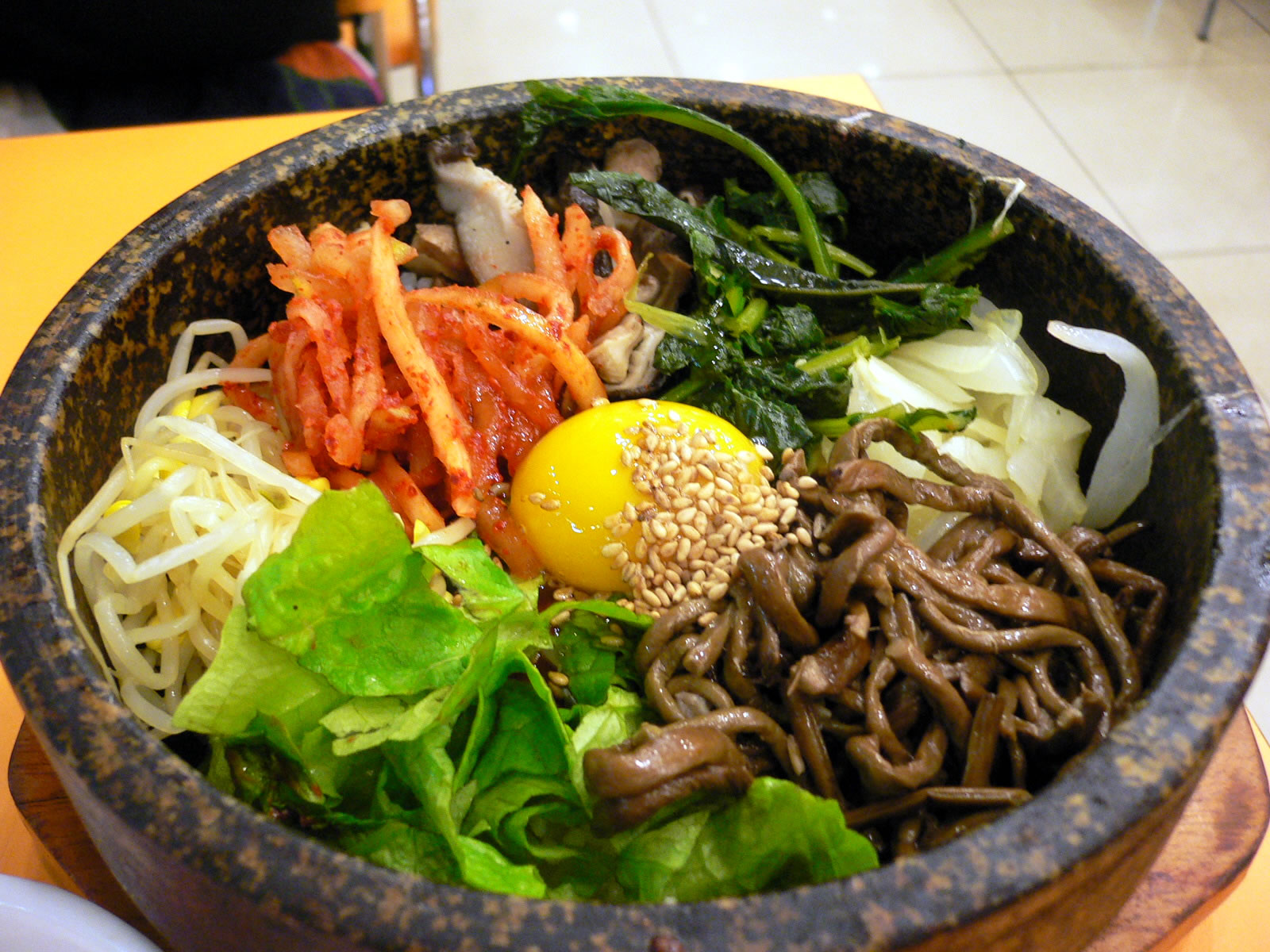
The last dish to arrive was bibimbap. It was very festive and included pretty much everything. A colorful and tasty assortment of vegetables, meat, eggs and rice. Hot sauce is added afterwards before mixing everything together.


For dessert, I had tempura ice cream, which is basically fried ice cream. I was not satisfied. The ice cream had at least a one inch thick layer of just basically, dough.


Luckily, my cousin had ordered green tea mochi. So maybe it's a Japanese treat rather than a Korean one, but that's ok. Not only was it's appearance more appealing, it was sweet and light. A little delight to end the meal happily.


Bibimbap picture uploaded from Wikipedia.com

Bento Box

Japanese food have always been a favorite of mine. Just the other day I ordered a bento box, the first I've had in many years. What I love about this little box is that instead of scanning the entire menu for something you want, the bento has it all. Rice, veggies and meat, all elaborately packaged in an appealing lunch box. Each type of food, presented in it's very own section of the container. My lunch consisted of aburaage, sushi rolls, a salad and of course, miso soup.


This brings me back to a week ago when I was at another Japanese restaurant. We had ordered a plate of sashimi combo which consisted of meat from five different seafood. The thought of eating raw meat was never very appealing to me, but then I figured, why not, it's food anyways. My first piece was sake, or salmon, I decided to start with a safe approach, knowing that it's on my list of top favorite fishes. With a little soy sauce and wasabi, it was the perfect bite. A smooth texture with a pleasant taste. How tasty, why don't I try another. I picked up a piece of hamachi, or yellowtail and into the soy sauce and wasabi it goes. Though different from the salmon, it was another yummy bite. I was excited and proceded to try saba, or mackerel. This one just tasted fishy. Too fishy.


I followed it by eating a couple California rolls and finishing my unagi don, marinated in a sweet barbeque sauce, and miso soup. What's a Japanese meal without miso soup?


Bento box and miso soup pictures uploaded from Google.com